P-09 · SEE 352
Compared Air and Liquid Cooling for a 1 MW Data Centre
I compared two ways to remove heat from a 1 MW data centre and sized the refrigeration cycle left after direct-to-chip cooling.
What I did
Our team studied a proposed data centre in Vancouver. I wrote the heat-load and cooling-system parts of the report. The IT equipment alone releases 1 MW of heat; power losses, lighting, people and the building envelope add about 65 kW. I compared removing that heat through room air with carrying the rack load away in a warm glycol loop. I then used CoolProp to solve the refrigeration cycle for the heat left in the room.
What stood out
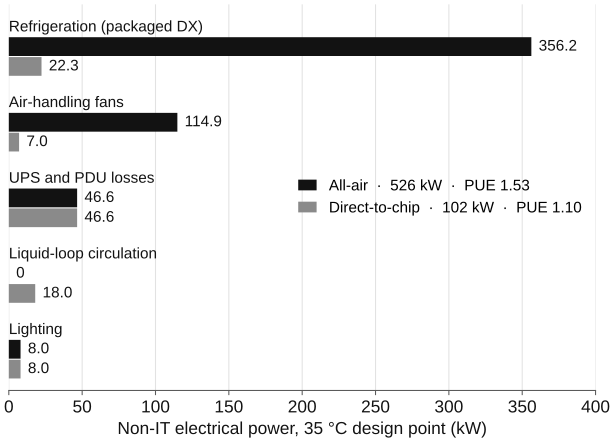
The liquid loop takes the 1 MW rack load, leaving about 72 kW for the air system once fan heat is counted. In the original calculation, power usage effectiveness falls from 1.53 to 1.10. For the remaining refrigeration, I chose R-1234ze(E): its calculated COP was 6.115, close to R-134a, with much lower stated global-warming potential. The larger loss came from the assumed 10 °C temperature approach on each side of the cycle.
What I would change
The liquid-cooling PUE leaves out pumping and dry-cooler fans on the heat-rejection side. It is a lower bound, not a facility prediction. I also mixed two air-temperature rises in the baseline; using 12 °C consistently brings its PUE to about 1.48. The comparison still favours liquid cooling, but I should have caught both boundaries before presenting the result. A useful next step would price the exchanger area needed to reduce those 10 °C approaches. I explored a related exchanger model in P-10.