P-05 · SEE 225
Off-Grid Run-of-River Hydro
Designed a 100 kW run-of-river hydroelectric system for an off-grid facility in British Columbia, replacing diesel generation with hydro power at a modeled LCOE of 1.65¢/kWh.
The Problem
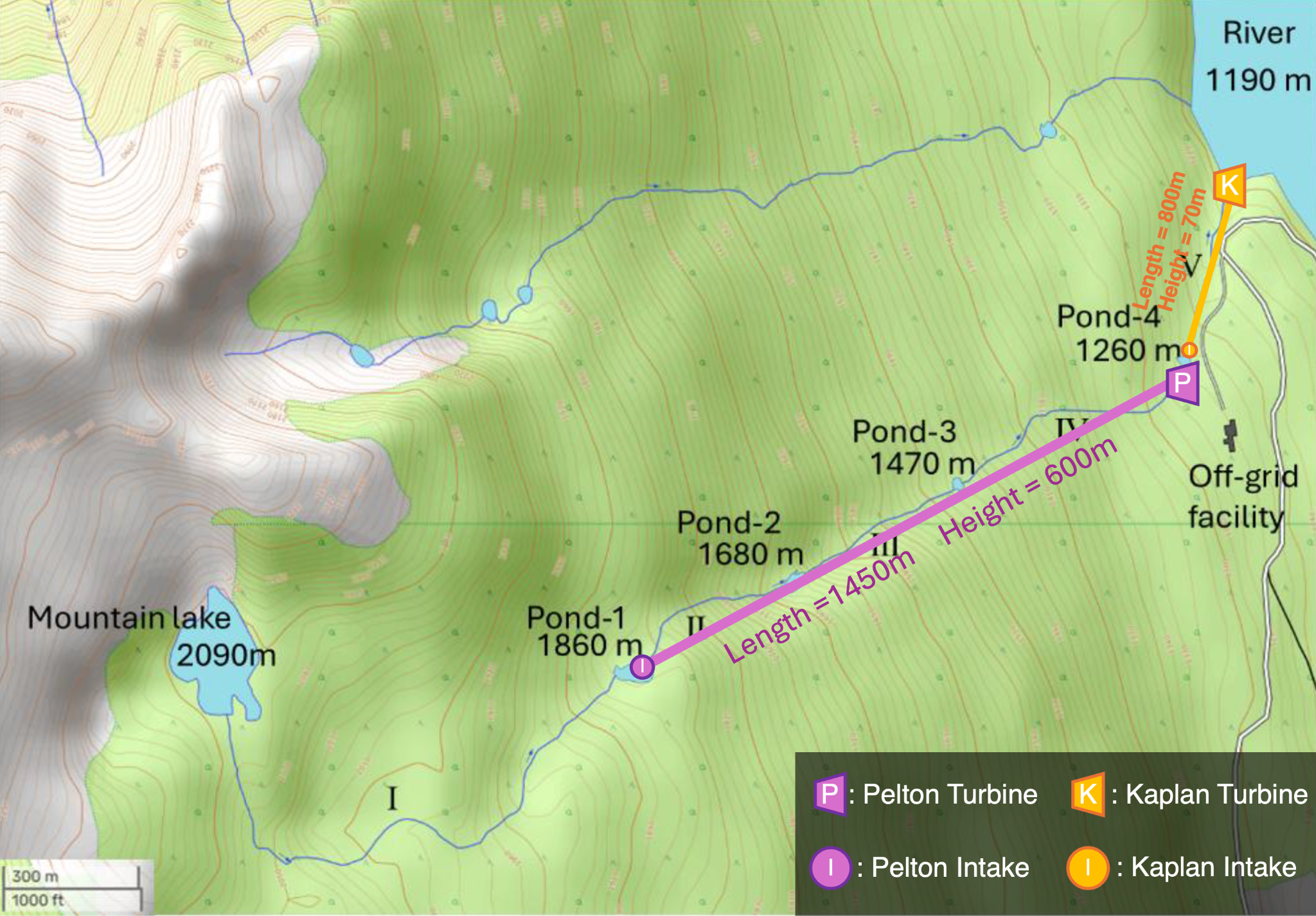
Most off-grid communities in British Columbia still rely on diesel generation. Diesel is operationally simple, but economically punitive and emissions-intensive. Our team was given a mountainous stream system with roughly 900 m of total elevation drop across five pools and asked to design a hydroelectric system capable of delivering a steady 100 kW year-round. The system had to satisfy three hard constraints: no more than 10% stream diversion at any intake, in-pipe pressure below 90% of rated pressure, and continued operability under a 1-in-10-year drought that reduced flow by 40%.
The Design
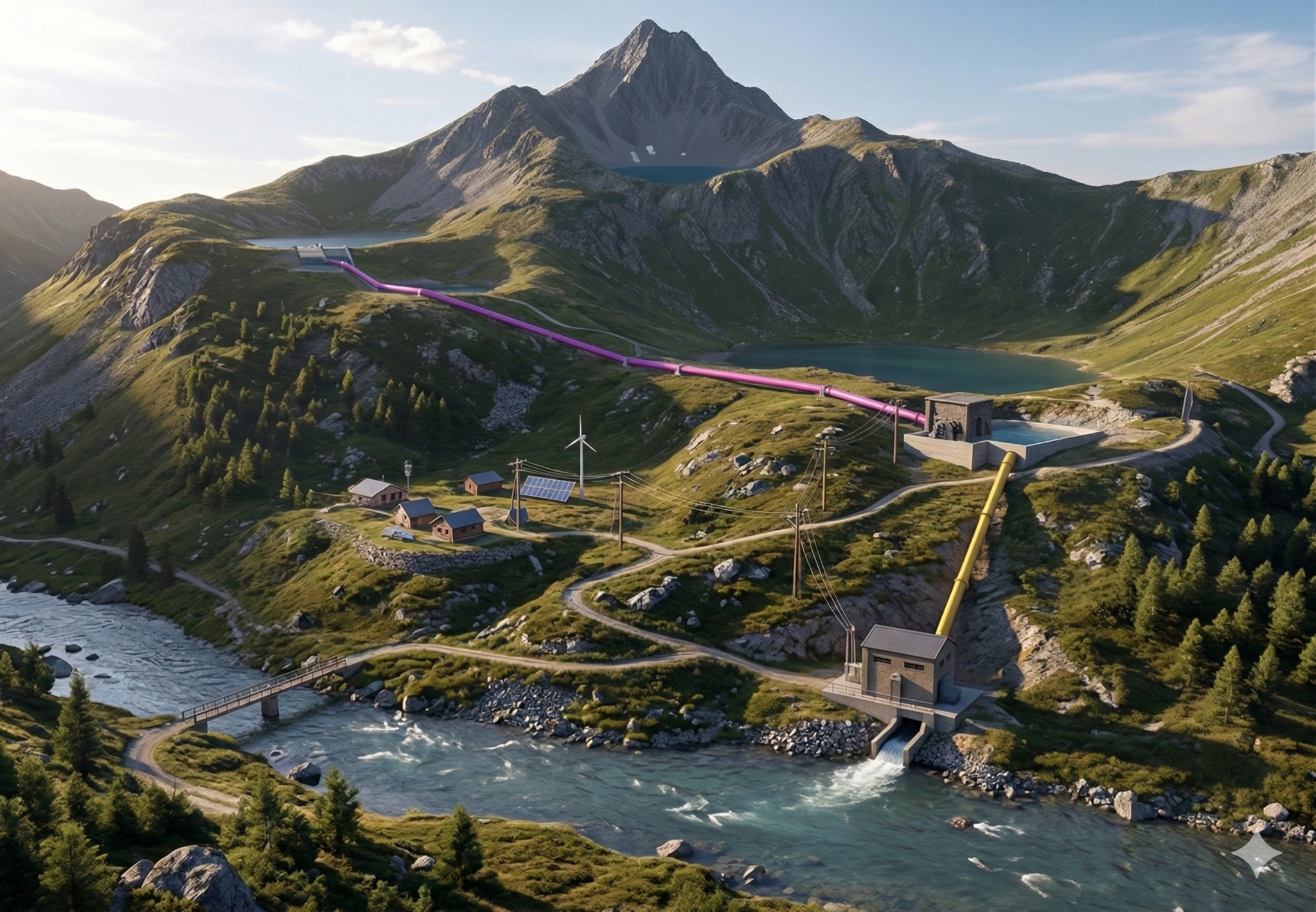
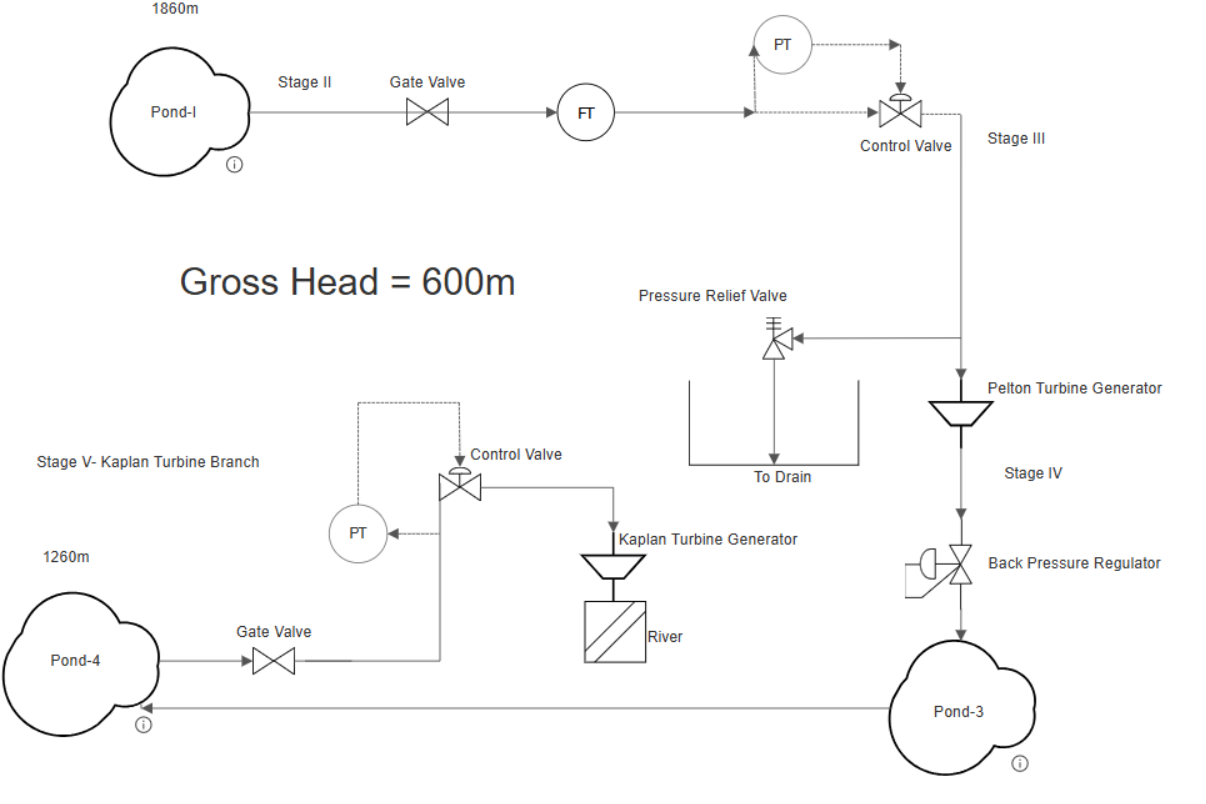
We selected a two-turbine configuration after evaluating three alternative concepts. The final system pairs a medium Pelton turbine on the high-head section with a small Kaplan turbine on the lower-head section. The Pelton stage draws from Stage II and discharges to Pond 4 through 1,450 m of 0.15 m thin-wall steel penstock across a 600 m gross head. The Kaplan stage uses an 800 m PVC line across the final 70 m drop to the river. In the worst month of an average year, the system produces 100.6 kW.
The core engineering problem was system-level optimization under coupled hydraulic and cost constraints. Pipe diameter governed both head loss and capital cost. Since frictional and minor losses scale with velocity squared, diameter changes had an outsized effect on usable head. We ran diameter and material sweeps in Excel across the candidate stream segments and found that 0.15 m thin-wall steel on the Pelton branch sat at the cost-performance optimum. Smaller diameters imposed excessive friction losses. Larger diameters recovered only marginal additional head while driving up steel cost.
What I Found Interesting
The drought-year analysis clarified the real decision criterion. One of our earlier concepts attempted to maintain 100 kW even under the 40% drought condition by oversizing the hydro system with three Pelton turbines and steel throughout. It still failed to hit the target and pushed installed cost to about $460,000. That result made the design logic clear. Building for an extreme edge case was economically irrational. A hybrid strategy with hydro sized for the normal-year constraint set, plus limited diesel use during drought conditions, produced the stronger engineering answer.
Outcome
Final installed cost was $179,800. The modeled LCOE came out to 1.65¢/kWh, versus roughly $1/kWh for diesel in the project assumptions. The design reduces operating cost by roughly a factor of 60 and avoids about 645 tonnes of CO₂e annually in a normal year. Over a 20-year project life, the report estimated an ROI of 94.84 under the stated assumptions. What mattered to me was the structure of the exercise. It required taking a real site, a real constraint set, and a finite catalogue of components, then reducing that into a design that is technically defensible and economically coherent.